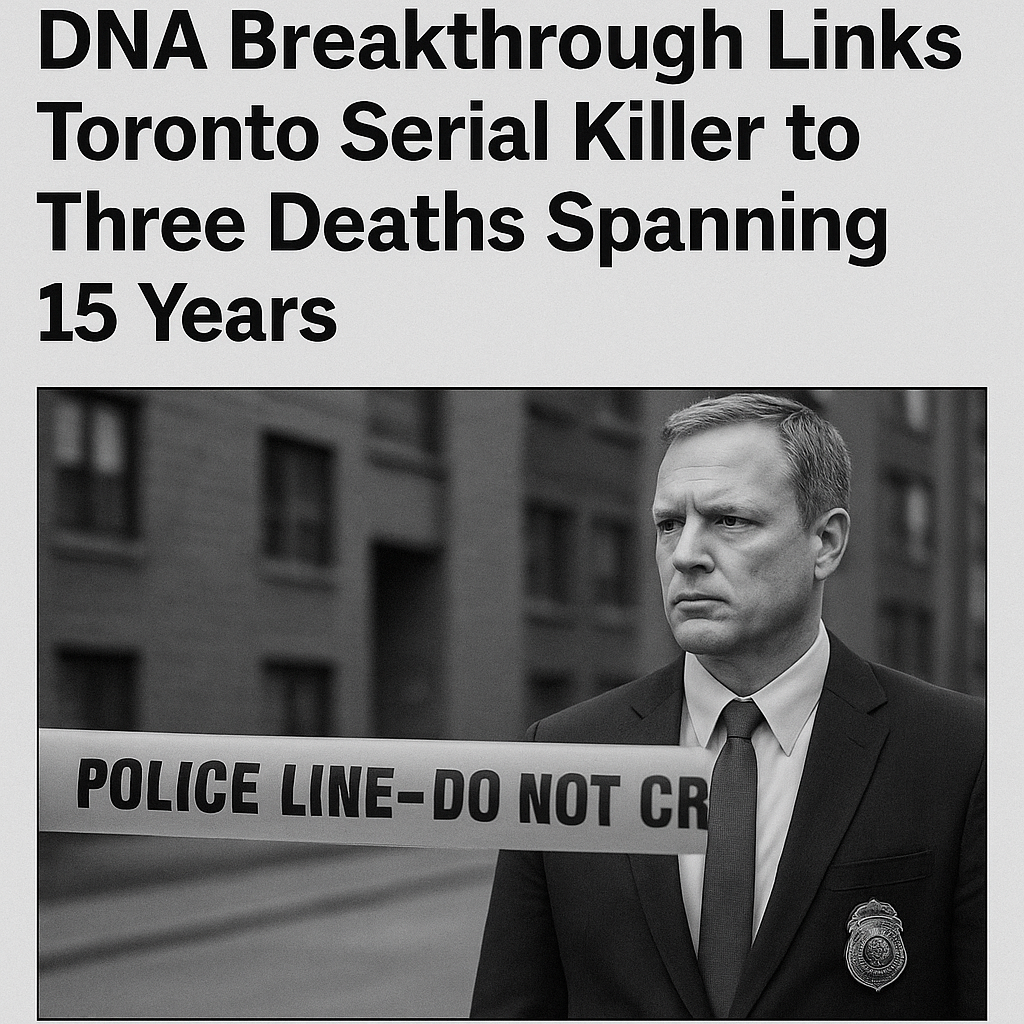
Introduction: A Cold Case Breakthrough Decades in the Making
More than four decades after the first victim was found, Toronto police say they have finally identified the man responsible for a series of killings that haunted investigators for years and left families searching for answers. Through advances in forensic DNA technology, police have linked a single suspect — Kenneth Smith — to the deaths of three women whose lives ended violently between the early 1980s and the late 1990s.
The announcement, made by Toronto police in collaboration with the Ontario Provincial Police (OPP), marks a significant milestone in three long-standing investigations that once had little evidence, no witnesses, and no clear connections between victims. Authorities now believe the confirmed cases may represent only part of Smith’s violent history, raising the possibility of additional victims yet to be identified.
A Timeline of Violence: Three Women, Three Different Lives
Different Backgrounds, Shared Fate
Although the victims came from very different walks of life and had no known ties to one another, investigators say their cases are now bound together by one irrefutable factor: DNA. Each woman disappeared under different circumstances, was killed in a different manner, and was found in a different location. Yet forensic evidence indicates they all crossed paths with the same offender.
Below is a detailed look at each case as investigators have now reconstructed them.
The 1982 Killing of Christine Prince
A Young Woman Far From Home
Christine Prince had crossed the Atlantic from Wales seeking opportunity and new experiences in Toronto. At 25, she was working as a live-in nanny, settling into life in a bustling city far different from where she grew up. She had plans, ambitions, and was, as her family would later describe, “full of life.”
Her Last Known Movements
On June 21, 1982, Prince was last seen riding a streetcar on St. Clair Avenue West near Bathurst Street shortly after 1 a.m. A routine route home should have taken her safely back to where she lived. Instead, she vanished somewhere along the way.
A Disturbing Discovery
The next morning, her body was found in the Rouge River near the Toronto Zoo. She had been sexually assaulted, brutally beaten, and thrown into the water. The violence of the attack shocked even seasoned investigators. With no witnesses, no apparent motive, and no suspect, the case quickly went cold.
The 1983 Disappearance and Murder of Claire Samson
A Final Sight on a Downtown Street
Just over a year later, another young woman’s life ended under similarly tragic circumstances. Claire Samson, 23, was last seen on September 1, 1983, in front of the former Essex Hotel on Jarvis Street. Witnesses reported she entered a car with an unknown man — a detail that provided a faint lead but little else for investigators to pursue.
A Body Found Far From the City
The following day, Samson’s body was discovered in a wooded area near Highway 93, just north of Barrie. She had been shot in the head with a small-calibre firearm.
Though the case drew significant media attention at the time, investigators again hit a dead end. There was no evidence to indicate who had driven her away from downtown Toronto or why she had been targeted. Without forensic breakthroughs, her file, too, faded into the long list of unsolved homicides.
The 1997 Stabbing Death of Gracelyn Greenidge
An Employee Fails to Show Up for Work
The final known victim, 41-year-old nursing assistant Gracelyn Greenidge, was discovered 14 years after the first killing. On July 29, 1997, a co-worker went to check on her after she failed to report for her shift — something completely out of character.
A Violent Scene Inside Her Apartment
Inside her apartment at 50 Driftwood Avenue in North York, the co-worker found Greenidge dead from multiple stab wounds. Unlike the previous two cases, the crime happened indoors, in a private residence. Again, no clear suspect emerged, and the lack of forensic tools available at the time severely limited the investigation.
How DNA Revived Three Forgotten Cases
A Breakthrough Decades Later
For years, all three cases stood independently, with no indication that a serial predator was responsible. That changed in 2016, when forensic experts discovered a DNA connection between the murders of Prince and Samson. It was the first tangible proof linking the two women and the first real lead in both cases in more than 30 years.
An Additional Link in 2017
The following year, a similar DNA match was found in Greenidge’s killing, firmly tying her murder to the same unknown perpetrator. Suddenly, three cases that once seemed isolated became the focus of a unified investigation.
A Suspect Identified
Ultimately, the DNA belonged to Kenneth Smith, whom investigators now identify as the man responsible for the deaths. Police have not publicly detailed Smith’s history, but his DNA profile had never been connected to these cases until recent advances in forensic analysis made such matches possible.
Authorities have not said whether Smith is still alive, deceased, or incarcerated for other crimes — only that he has been definitively linked to the murders.
Investigators: “Crimes of Opportunity” With No Known Connections
Even with the DNA matches, the cases puzzled investigators because of how little the victims shared in common.
Police Found No Personal Links
According to OPP Chief Superintendent Karen Gonneau, detectives could find no evidence that Prince and Samson — the two earliest victims — knew each other. Their lifestyles differed, their social circles differed, and their murders were carried out in completely separate ways.
“Surprisingly, investigators found no personal connection between Christine and Claire,” Gonneau said. “No one in their lives linked them together, and even the manner of their death was different. The only thing that linked them was the offender’s DNA.”
Randomness Made the Cases Harder to Solve
Police now believe the attacks were “crimes of opportunity,” meaning the victims were likely chosen at random. This, investigators say, explains why the cases were difficult to connect for so many years.
Are There More Victims? Police Say It’s Possible
With such a long span of time between the killings — 1982, 1983, and 1997 — investigators say it is unlikely that the offender committed only these three murders. The 14-year gap between the second and third case, in particular, raises significant questions.
Police are now encouraging anyone with information about Smith or unsolved cases from those decades to come forward. They also plan to review additional cold cases from the same period to determine whether the DNA may provide clarity elsewhere.
Conclusion: Justice, Even When Delayed, Still Matters
For the families of Christine Prince, Claire Samson, and Gracelyn Greenidge, the identification of Kenneth Smith brings long-awaited answers, though not closure in the fullest sense. Their loved ones cannot be brought back, but knowing the truth offers a measure of resolution that decades of uncertainty denied them.
The investigation also highlights the transformative power of forensic science. Cases that once seemed unsolvable have been revived thanks to technologies that did not exist at the time of the murders.
As police continue to probe Smith’s past and search for potential additional victims, the hope is that more families may someday receive the answers they have been waiting for — no matter how much time has passed.
Leave a Reply