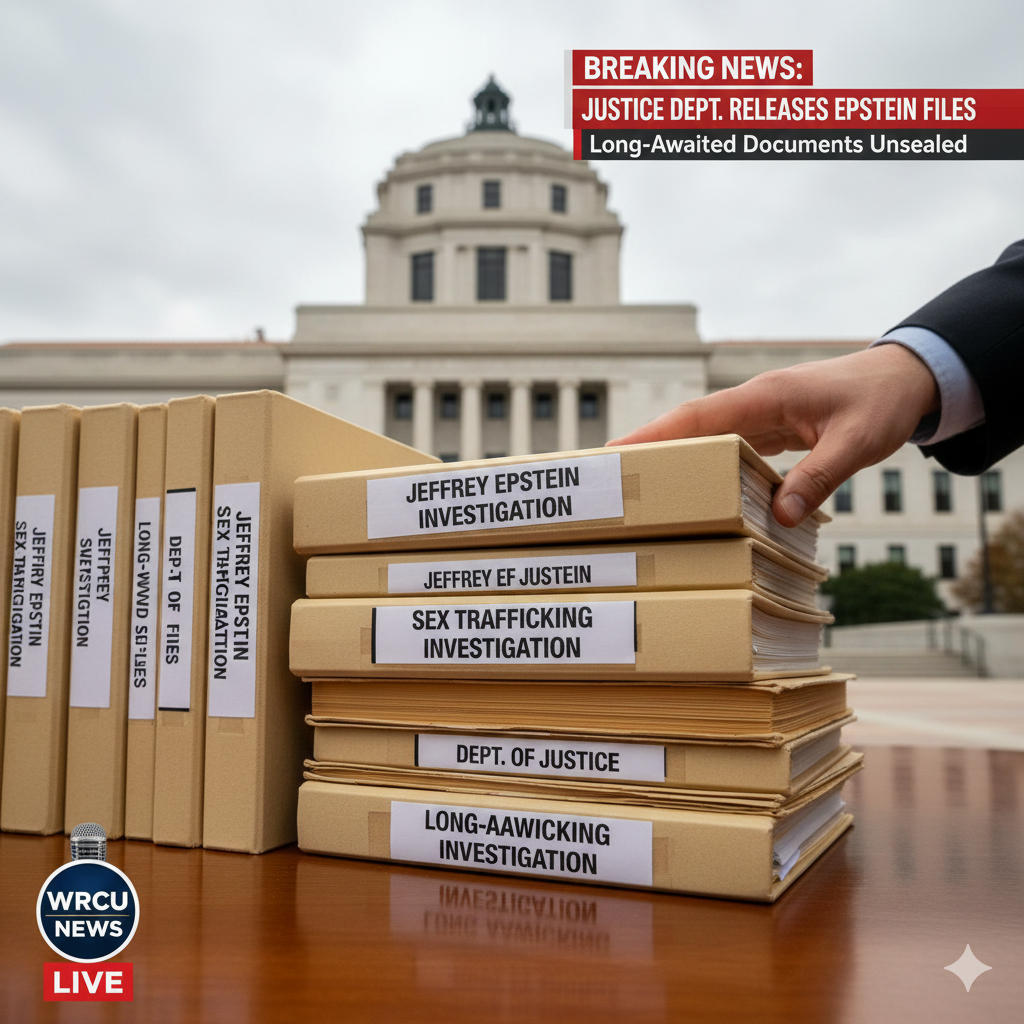
The U.S. Justice Department has begun releasing a vast collection of records tied to its investigation into Jeffrey Epstein, the disgraced financier and convicted sex offender whose case has long fueled public outrage, political controversy, and conspiracy theories. The move comes after years of pressure from lawmakers, victims, and the public demanding transparency around how authorities handled allegations that Epstein sexually abused dozens of young women and underage girls while maintaining close ties to some of the world’s most powerful figures.
The initial release of documents on Friday marks a significant — though incomplete — step toward opening government files that span nearly two decades of investigations, prosecutions, and internal decision-making related to Epstein’s crimes and death.
A Release Driven by Congressional Mandate
The disclosure follows a law passed by Congress that set a firm deadline for the Justice Department to make most Epstein-related records public. The legislation, signed by President Donald Trump on Nov. 19, required the department to release files within 30 days, overriding months of resistance from the administration and Republican leadership.
While the Justice Department began complying with the law on Friday, officials acknowledged the release would extend beyond the deadline.
Scope and Timeline of the File Release
Deputy Attorney General Todd Blanche said the department expected to release “several hundred thousand” records on Friday, with hundreds of thousands more to follow in the coming weeks. The files include photographs, call logs, interview transcripts, and grand jury testimony connected to Epstein’s criminal cases and related investigations.
Despite the sheer volume of material, officials cautioned that the public should not expect immediate revelations. It remains unclear how much new or substantive information the records contain, particularly regarding Epstein’s relationships with influential individuals.
Public Anticipation and Lingering Questions
The release has generated intense public interest, driven by longstanding questions about whether Epstein’s wealth and connections shielded him — or others — from accountability. Survivors and advocates have repeatedly demanded answers about why an early federal investigation into Epstein collapsed in 2008 and whether powerful associates were ever scrutinized.
For many, the files represent a chance to understand how Epstein evaded serious consequences for years despite mounting evidence of abuse.
Limits on Redactions Under the Law
The law authorizing the release allows redactions only to protect victims’ identities or ongoing investigations. Importantly, it explicitly prohibits withholding or censoring records to avoid embarrassment, reputational harm, or political sensitivity.
That provision was central to lawmakers’ push for transparency, ensuring that discomfort or political fallout would not be grounds for secrecy.
Political Pressure and a Shifting White House Stance
The legislation’s passage marked an unusual moment of bipartisan cooperation, overcoming resistance from President Trump and Republican leaders who had initially sought to keep the files sealed.
Trump’s position evolved as congressional action became unavoidable. He ultimately argued that releasing the records was necessary to prevent the Epstein issue from continuing to distract from the Republican agenda.
Calls for Expanded Investigations
Attorney General Pam Bondi said in November that she ordered a senior federal prosecutor to examine Epstein’s ties to Trump’s political rivals, including former President Bill Clinton. The directive followed public pressure from Trump, though he did not specify what alleged crimes should be investigated.
None of the individuals named by Trump in public statements have been accused of sexual misconduct by Epstein’s victims, and prosecutors have not announced any new charges stemming from those claims.
Earlier this year, Trump had dismissed some of his own supporters as “weaklings” for embracing what he called the “Jeffrey Epstein hoax,” highlighting the political tension surrounding the issue.
Origins of the Epstein Case
The Epstein scandal began in 2005, when police in Palm Beach, Florida, opened an investigation after the family of a 14-year-old girl reported that she had been molested at Epstein’s mansion. The case soon expanded, with the FBI joining the inquiry and multiple underage girls coming forward.
Many said they were paid to give Epstein sexual “massages,” a pattern that investigators later described as systematic exploitation.
A Controversial Plea Deal
Despite the growing body of evidence, Epstein avoided federal prosecution in 2008 through a highly controversial plea agreement. He pleaded guilty to state prostitution charges involving a minor and was sentenced to 18 months in jail, serving much of that time on work release.
The deal sparked outrage among victims and legal experts, many of whom argued it allowed Epstein to escape meaningful punishment and silenced his accusers.
Survivors’ Long Fight for Accountability
Epstein’s victims spent years challenging the plea deal through civil lawsuits, seeking to have it overturned and to hold authorities accountable for what they saw as a miscarriage of justice.
One of the most prominent accusers, Virginia Giuffre, alleged that Epstein trafficked her to powerful men starting when she was 17 years old. She named billionaires, academics, U.S. politicians, and Britain’s Prince Andrew — now Andrew Mountbatten-Windsor — among those she said abused her.
All denied the allegations, and prosecutors never filed charges related to Giuffre’s claims. Still, her testimony became central to public suspicion that powerful interests were protected from scrutiny.
Giuffre died by suicide in April at her farm in Western Australia at age 41, a development that renewed calls for transparency and justice.
Epstein’s Arrest, Death, and Renewed Scrutiny
Federal prosecutors in New York revived the case in 2019, charging Epstein with sex trafficking. His arrest was widely seen as a long-overdue reckoning, but it ended abruptly when Epstein was found dead in his jail cell just a month later.
His death, ruled a suicide, intensified public distrust and conspiracy theories, particularly given the failures in jail supervision that allowed it to happen.
Conviction of Ghislaine Maxwell
After Epstein’s death, prosecutors turned their focus to his longtime associate, Ghislaine Maxwell. The British socialite was convicted in late 2021 of recruiting and grooming underage girls for Epstein’s abuse and was sentenced to 20 years in prison.
Maxwell was recently transferred from a low-security federal prison in Florida to a minimum-security prison camp in Texas after being interviewed by Deputy Attorney General Blanche. Her lawyers continue to argue that she should never have been tried or convicted.
In July, the Justice Department stated it had found no evidence sufficient to prosecute any additional individuals.
A Case Already Rich in Public Records
Even before the latest disclosures, an extensive body of Epstein-related material was already public. Over the years, journalists and courts have released flight logs, address books, emails, police reports, deposition transcripts, and grand jury documents.
Yet demand for more information has remained intense, especially regarding Epstein’s interactions with high-profile figures such as Trump, Clinton, and Prince Andrew.
Clarifying What the Files Do — and Do Not — Mean
Legal experts caution that the appearance of a name in investigative records does not imply wrongdoing. Both Trump and Clinton had social relationships with Epstein, but neither has been accused of criminal conduct related to his abuse.
Prince Andrew has consistently denied Giuffre’s allegations. However, the fallout has been severe: King Charles III stripped him of his royal titles earlier this year following the posthumous publication of Giuffre’s memoir.
Conclusion: Transparency Arrives, but Closure Remains Elusive
The release of Epstein investigation files represents a major moment in a case that has come to symbolize failures of justice, inequality before the law, and institutional secrecy. While the documents may shed light on how authorities handled Epstein and his associates, they may not deliver the definitive answers many are seeking.
For survivors, the disclosures are about more than names and records — they are about accountability and acknowledgment of harm long ignored. As additional files are released in the weeks ahead, public scrutiny will likely intensify, even as the central question remains unresolved: whether the full truth of Jeffrey Epstein’s crimes and the system that enabled them will ever be fully known.
Leave a Reply