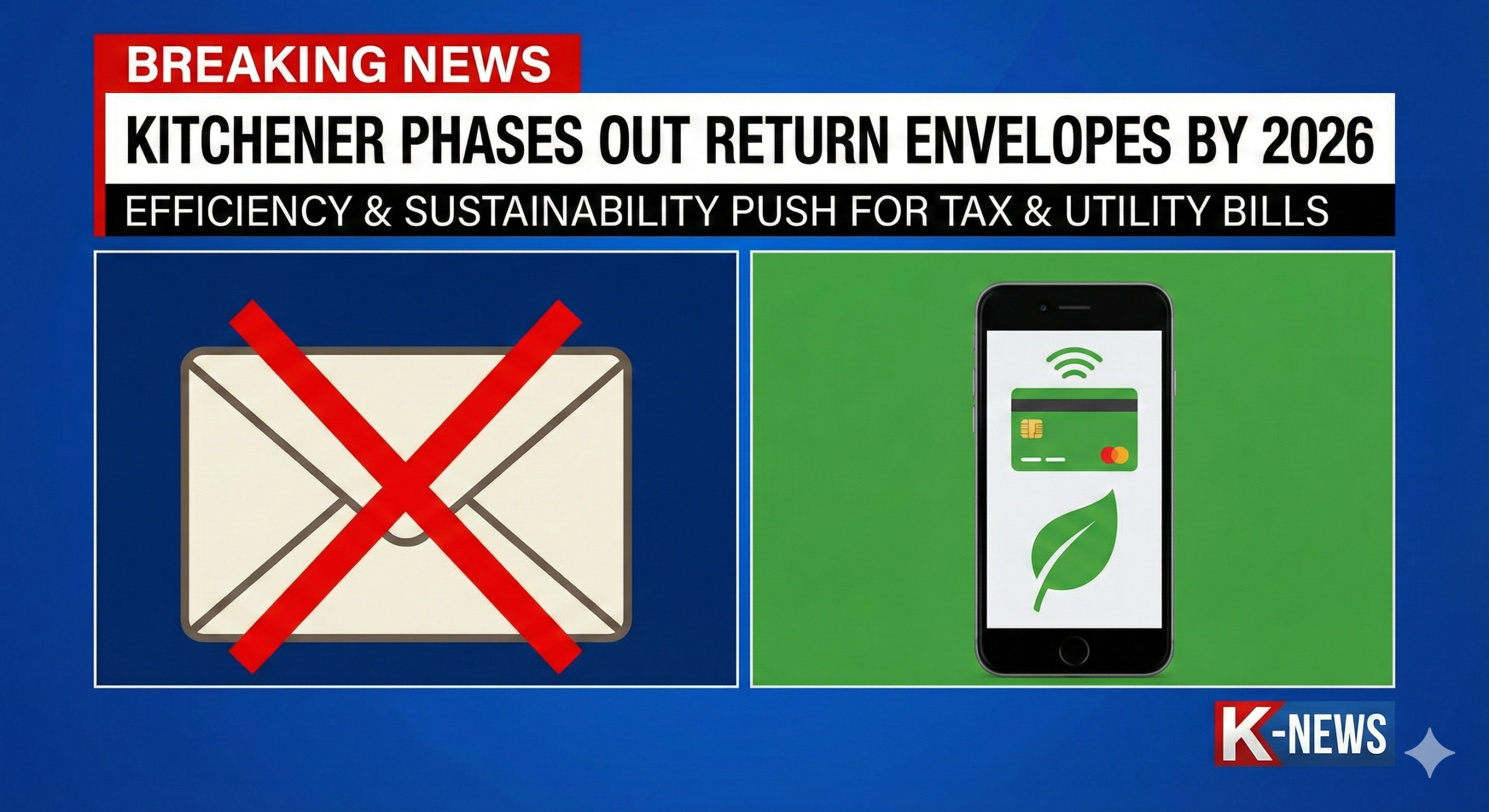
The City of Kitchener is preparing for a small but symbolically important change that will affect thousands of residents starting in 2026. Beginning February 1, 2026, Kitchener will stop including return envelopes with mailed tax and utility bills. The move is being described by city staff and a majority of council as a step toward greater environmental responsibility, reduced waste, and improved operational efficiency — but not everyone agrees with the decision.
This change comes as many municipalities across Ontario and Canada continue to look for ways to modernize systems, reduce paper consumption, and shift residents to digital services like e-billing and online payments.
Why Is Kitchener Removing Return Envelopes?
For decades, it has been standard practice for cities to include a return envelope with paper bills, making it easy for residents to mail their payment. However, Kitchener’s recent review of its billing and mailing operations revealed something surprising:
-
The city sends out about 78,000 envelopes per year
-
Only 6,400 envelopes are actually returned with payments
-
That means over 70,000 envelopes go unused annually
City staff concluded that providing so many unused envelopes was costly and wasteful. By discontinuing them, Kitchener expects to save about $5,400 per year in materials and handling costs.
But the savings are not just financial. The move is also expected to reduce paper waste and lower the environmental impact caused by producing, transporting, and disposing of unused envelopes.
A Push Toward E-Billing and Digital Payments
A major part of Kitchener’s plan is to encourage residents to switch to e-billing and other digital payment methods.
Today, many residents already pay their utility and tax bills through:
-
Online banking
-
Automatic withdrawals
-
City’s e-billing system
-
In-person payments at financial institutions
City officials noted that residents who already use e-billing or bank payments do not receive return envelopes anyway. The change mainly affects those who prefer to pay by mail using paper cheques.
By removing the envelope, the city hopes more people will consider switching to digital options, which are:
-
Faster
-
More reliable
-
More environmentally friendly
-
Less expensive to manage
In an age when most personal and business communication happens digitally, city leaders believe this transition is both practical and inevitable.
Debate Inside the Council Chamber
While the change may seem straightforward, it sparked an interesting debate during a Planning & Strategic Initiatives Committee meeting.
Who Voted Against the Decision?
Councillors Debbie Chapman and Stephanie Stretch voted against the proposal. Their main argument was that removing the return envelopes may not actually be as “green” or effective as the city expects.
Chapman raised a key concern:
“By doing this, residents are still going to go out and buy envelopes, so it’s not really greener… those who just prefer to pay that way are going to continue doing it.”
Her point was that residents who still want to pay by mail may just purchase envelopes themselves, which could simply shift the environmental impact from the city to individuals without actually reducing it.
Who Supported the Change?
Ward 1 Councillor Scott Davey strongly supported the decision and dismissed the idea that eliminating the envelope would make no difference.
He compared it to people choosing between driving a car and taking public transit:
“If we’re trying to be a greener and more efficiently run city, then this is the type of efficiencies we should be supporting.”
Davey’s argument was that cities must sometimes make small, firm changes to encourage long-term behavior shifts. In his view, removing return envelopes is a necessary part of that broader transition toward sustainability.
How Kitchener Compares with Other Ontario Cities
Before making the final recommendation, Kitchener examined what other municipalities in Ontario were doing. According to a report presented to council, the city reviewed 10 other municipalities and found that the majority had already eliminated return envelopes.
Cities That Do NOT Use Paper Return Envelopes
-
Toronto
-
Waterloo
-
Cambridge
-
(And several other unnamed municipalities)
Cities That Still Use Paper Return Envelopes
-
Vaughan
-
Ottawa
This comparison helped strengthen the case that Kitchener is not out of step with modern administration. In fact, the city is simply catching up with an emerging standard.
What This Means for Kitchener Residents
Starting February 1, 2026, if you receive a paper tax or utility bill in the mail, it will no longer include a return envelope. If you still want to pay by mail, you can:
-
Use your own envelope
-
Address it to the city’s payment department
-
Attach your cheque and mail as usual
However, residents will also be strongly encouraged to switch to digital options, including:
-
Signing up for e-billing
-
Paying through online or mobile banking
-
Using pre-authorized payments
For many residents, especially seniors or those who are less comfortable with technology, this might require adjustment. The city is expected to provide communication and support before the change takes effect to ensure no one is surprised or left behind.
Environmental Impact: Small Change, Big Signal
On its own, a $5,400 saving and 78,000 fewer envelopes per year may seem like a minor change. But in terms of environmental impact, even small reductions in paper waste can make a difference over time.
Each envelope represents:
-
Paper from trees
-
Ink used in printing
-
Energy used in manufacturing
-
Fuel used in shipping
-
Waste added to landfills if unused
By removing these envelopes, Kitchener is sending a clear message that every small step toward sustainability matters.
It also reinforces the idea that modern cities must rethink long-standing habits and systems in order to create a more environmentally responsible future.
A Sign of Things to Come
Kitchener’s decision could serve as a model for other municipalities still debating similar changes. As cities continue to digitize services and reduce operational costs, residents can expect to see more shifts like this in the coming years, including:
-
Less paper billing
-
More online services
-
Greater reliance on automated systems
-
Increased push for digital literacy
While not everyone will be pleased with the change, it reflects a broader reality: the future of city services is increasingly paperless, digital, and efficiency-focused.
Conclusion
Kitchener’s plan to phase out return envelopes for tax and utility bills, effective February 1, 2026, is a practical step toward reducing waste, lowering costs, and encouraging digital adoption. Though the decision has faced some criticism, it aligns with trends seen across Ontario and reflects the city’s commitment to sustainability and modernization.
For residents, the change may be small — just one less envelope in the mailbox — but it represents a much larger transformation in the way cities operate in the digital era.
Leave a Reply