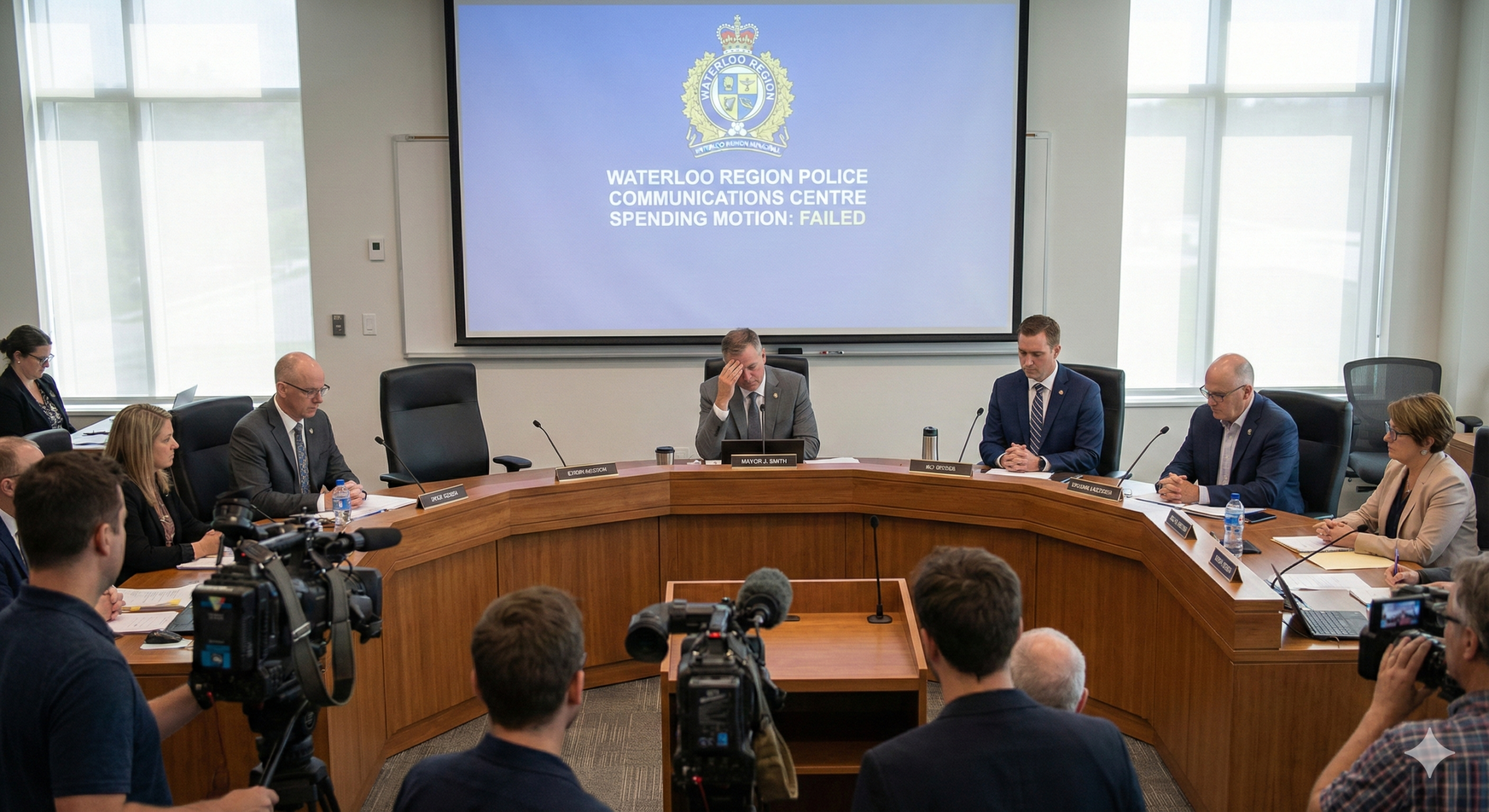
The Region of Waterloo’s Budget and Strategic Planning Committee concluded a pivotal meeting Tuesday as councillors worked through the final stages of budget deliberations, grappling with competing priorities amid ongoing affordability concerns. One of the most debated issues of the day was a motion from Kitchener Mayor Berry Vrbanovic seeking to halt approval of a proposed $173 million capital expenditure for a new regional emergency services communications centre. After extensive discussion, the committee voted to defeat the motion, allowing the police capital budget to move forward unchanged.
The outcome highlighted the ongoing tension between fiscal restraint and long-term infrastructure investment, particularly as municipalities across Ontario face rising costs, limited revenue tools, and pressure from residents concerned about both affordability and public safety.
Budget Deliberations Set the Stage for Heated Debate
The committee meeting formed part of the Region of Waterloo’s final budget review process. Councillors were presented with an agenda containing 32 motions, each proposing adjustments or conditions to the region’s overall spending plan. These motions reflected a wide range of priorities, from service delivery and infrastructure to affordability and taxation impacts.
Among the motions introduced by Mayor Vrbanovic, one stood out for the amount of time and attention it commanded. The motion focused on the Waterloo Regional Police Service (WRPS) capital budget request, which includes $173 million for the construction of a new regional emergency services communications centre.
Scope and Cost at the Centre of the Dispute
Mayor Vrbanovic argued that while a new communications facility may be necessary, the scale and cost of the proposed project were excessive given the region’s current financial realities. He questioned whether the size of the building and the scope of the investment could be justified at a time when residents and municipalities are struggling with rising costs of living, housing pressures, and constrained municipal budgets.
The motion called for a clear distinction between the police service’s operating and capital budgets. Under the proposal, the committee would approve the WRPS operating budget, ensuring day-to-day policing services could continue uninterrupted. However, the capital budget would be sent back to the Waterloo Regional Police Services Board with instructions to rework the plan and reduce costs associated with the communications centre.
According to Vrbanovic, this approach would acknowledge the need for improved emergency communications while insisting on a project that better aligns with current affordability challenges.
Supporters Argue Centre Is Critical for Modern Policing
Opposition to the mayor’s motion was led by Regional Chair Karen Redman, who emphasized the importance of investing in modern emergency communications infrastructure. Redman told the committee that expert advice had consistently pointed to the need for a new facility to keep pace with evolving technology and policing demands.
Expert Advice and Future-Proofing
Redman referenced assessments from external consultants who evaluated the region’s emergency communications needs. She said their findings made it clear that investing now is necessary for Waterloo Region to remain effective in preventing and solving crime.
According to Redman, advances in technology and policing techniques mean that older facilities and systems can quickly become outdated. Delaying or downsizing the project, she suggested, could risk leaving the region behind at a time when public expectations for emergency response are increasing.
She framed the proposed communications centre not as a luxury, but as a strategic investment designed to support public safety well into the future.
Public Safety a Key Concern for Residents
Councillor Doug Craig echoed Redman’s remarks, noting that safety remains one of the top issues raised by residents across the region. He argued that the new communications hub would play a central role in improving coordination among emergency services, enhancing response times, and supporting safer communities.
Craig said that beyond traditional policing concerns, residents frequently raise issues related to road safety and neighbourhood security. In his view, bringing advanced communications capabilities together under one facility would strengthen the region’s ability to respond to a wide range of emergencies more efficiently.
“Bringing this all together will only improve safety,” Craig told the committee, reinforcing his belief that the investment aligns with public expectations.
Affordability Pressures Loom Large
Despite strong arguments in favour of the project, the sheer size of the $173 million price tag remained a central concern throughout the debate. Several councillors acknowledged that the request comes at a time when both municipalities and ratepayers are under significant financial strain.
Rising property taxes, inflation, and increased service demands have made budget decisions increasingly difficult. For many residents, affordability has become a defining issue, influencing how they view major capital projects funded through municipal budgets.
Provincial Downloading Adds to Municipal Strain
Councillor Craig also pointed to what he described as a lack of adequate financial support from the provincial government. He argued that municipalities are being forced to shoulder responsibilities that were downloaded by Queen’s Park without sufficient funding.
According to Craig, if the province were to fully cover the costs of programs it has transferred to municipalities, the Region of Waterloo would see a financial impact of approximately $217 million. He said this would translate into a per-person reduction of about $659, significantly easing pressure on local budgets.
Craig suggested that these broader structural issues are often overlooked when municipalities debate individual projects, leaving councils to “squeeze and manoeuvre within a budget that is very constraining.”
Committee Vote Defeats Mayor’s Motion
After extensive discussion, the Budget and Strategic Planning Committee voted 9–7 against Mayor Vrbanovic’s motion. Both Chair Redman and Councillor Craig voted in favour of approving the police services budget as presented, including the capital funding for the communications centre.
The narrow margin reflected the divided views within council, underscoring how contentious the issue remains. While a majority supported moving forward with the project, a significant minority shared the mayor’s concerns about cost, scale, and timing.
Mayor Reiterates Call for a “Right-Sized” Solution
Following the vote, Mayor Vrbanovic issued a statement to 570 NewsRadio clarifying his position. He emphasized that his motion was not intended to block the development of a new communications centre entirely, but rather to ensure that it is appropriately scaled to meet current needs.
Balancing Need and Affordability
Vrbanovic said his proposal clearly supported the WRPS operating budget while signaling opposition to the capital request in its current form. He described the proposed communications centre as “over-sized” and argued that approving it now would crowd out other pressing capital priorities across the region.
He acknowledged that most councillors agree a new communications facility is necessary. However, he stressed the importance of designing a centre that reflects known, present-day requirements rather than speculative future models that may or may not materialize.
In his view, fiscal responsibility requires a more cautious approach, especially during what he described as an ongoing affordability crisis affecting residents and municipalities alike.
Looking Ahead: A Broader Budget Conversation Continues
The defeat of Mayor Vrbanovic’s motion means the WRPS capital budget, including funding for the $173 million communications centre, remains intact as the Region of Waterloo moves toward finalizing its budget. However, the close vote and lengthy debate suggest that concerns about affordability, capital planning, and long-term sustainability are far from resolved.
As council continues its budget deliberations, the discussion around policing, public safety, and infrastructure investment is likely to remain a focal point. The challenge for regional leaders will be finding a balance between preparing for future needs and responding to present-day financial pressures faced by the community.
For residents of Waterloo Region, the decision underscores the complexity of municipal budgeting in an era marked by rising costs, evolving service demands, and heightened expectations for transparency and accountability.
Leave a Reply