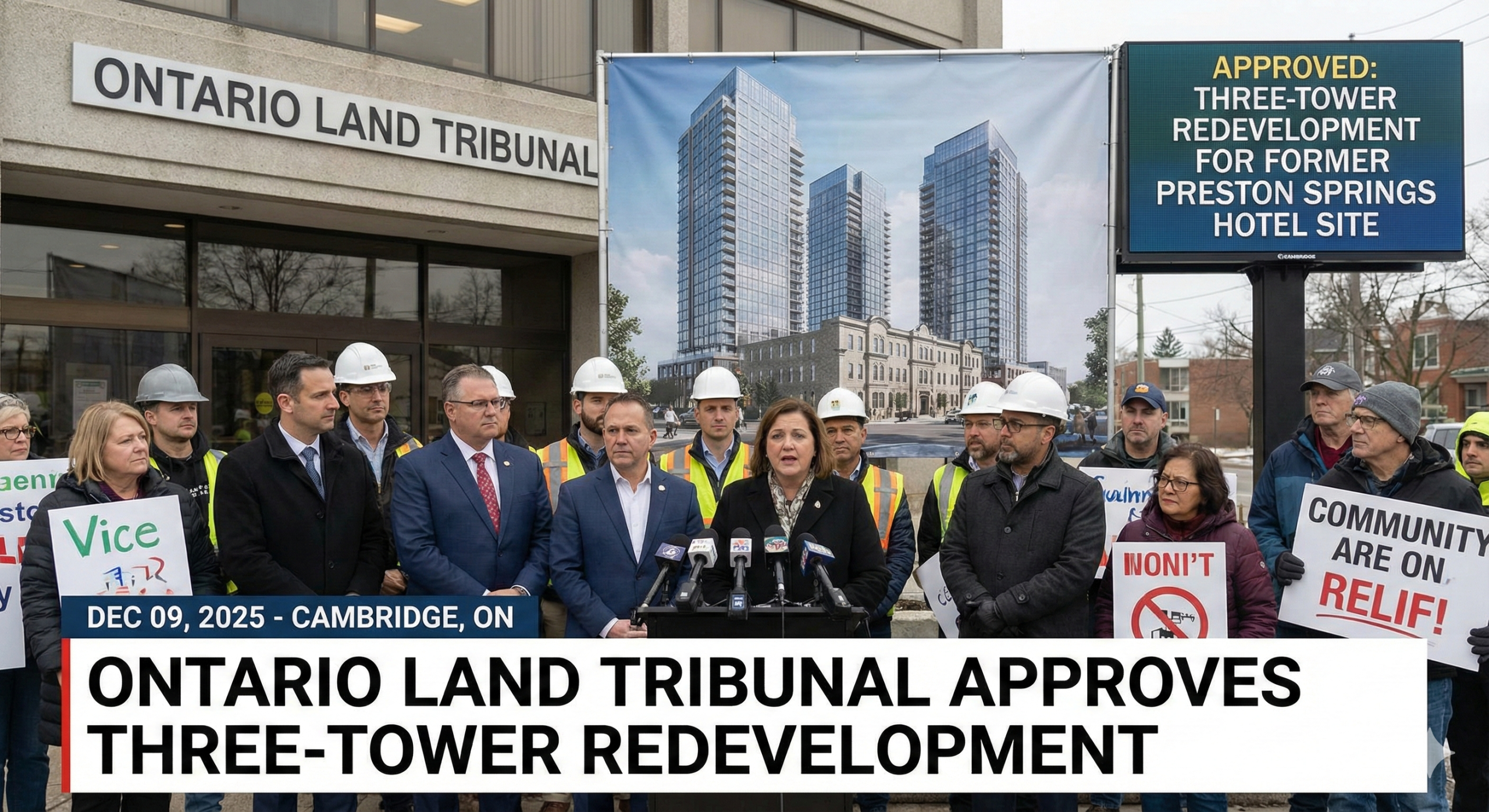
A Landmark Decision Clears the Path for Major Transformation in Cambridge’s Preston Neighbourhood
The long and controversial debate surrounding the future of the former Preston Springs Hotel lands has finally reached its conclusion. After years of uncertainty, halted plans, community discussions, and municipal pushback, the Ontario Land Tribunal (OLT) has given its approval for a three-tower residential development at the historic King and Fountain streets intersection in Cambridge.
This ruling, delivered in early December, settles an extended dispute between the City of Cambridge and Hasstown Holdings—the developer behind the proposed project. With the OLT’s decision now in place, the long-vacant property is set to undergo one of the most ambitious redevelopment efforts in the city’s recent history.
OLT Favors Higher Density Despite Municipal Concerns
City’s Restrictions Versus Developer’s Vision
The City of Cambridge had previously attempted to restrict the redevelopment by limiting the proposal to two towers with a height cap of 15 storeys. This was in contrast to Hasstown Holdings’ original design, which envisioned three towers standing 22, 24, and 26 storeys high.
The developer appealed the city’s height restrictions to the OLT, arguing that the property’s location—adjacent to key transit and growth corridors—justified greater density. After reviewing the evidence, the tribunal ultimately sided with Hasstown Holdings.
The approved design now includes:
-
Tower 1: 22 storeys
-
Tower 2: 20 storeys
-
Tower 3: 17 storeys
While still tall, the final heights reflect a slight reduction from the developer’s amended proposal, which had requested one additional floor for each tower.
Density, Heritage, and Compatibility Shape Final Outcome
Ward 7 Councillor Scott Hamilton, speaking on The Mike Farwell Show, emphasized that the OLT’s ruling aligned closely with recommendations previously issued by city planning staff.
Hamilton noted that as early as March 2024, city staff expressed support for Hasstown’s proposal, citing its compatibility with the area’s evolving urban landscape and the need to balance density with heritage protection.
“Staff said this was the best way to ensure compatibility, increase density, protect heritage, and help revitalize this important gateway to the city,” Hamilton said. “The OLT ended up siding almost exactly with what staff recommended.”
Transit Connectivity and Regional Growth Influenced OLT’s Decision
Location: A Key Determining Factor
One of the strongest arguments working in favour of Hasstown Holdings was the property’s strategic position within a Major Transit Station Area (MTSA). Hamilton explained that multiple regional transportation and housing initiatives already underway in the area played a major role in the tribunal’s ruling.
The proposed site is:
-
Less than 10 minutes on foot from a planned ION LRT station
-
Within walking distance of downtown Preston
-
A short drive from Highway 401, a major regional connector
These factors collectively bolstered the case for a more densely built environment.
“This is a gateway to downtown Preston,” Hamilton said. “The walkability, the upcoming ION station, and the proximity to the 401 all make this higher-density design far more appropriate compared to past proposals.”
Balancing Community Concerns With Future Needs
Hamilton acknowledged that many residents expressed anxiety about the scale of the project. Height, traffic, and neighbourhood character were among the most cited issues. While he said he listened to these concerns, he stressed that long-term planning and provincial rules must guide final decisions.
“Change isn’t easy,” he said. “But as councillors, we have to look ahead—what’s best for today, tomorrow, and decades from now. We also have to follow provincial policy, the Regional Official Plan, the city’s own Official Plan, and staff recommendations. This proposal met all of those criteria.”
City of Cambridge Expresses Disappointment but Accepts Tribunal’s Authority
Mayor Jan Liggett Responds to OLT Decision
In response to the tribunal’s ruling, the City of Cambridge released an official statement on behalf of Mayor Jan Liggett, who reiterated her and council’s opposition to the three-tower plan.
Liggett said the OLT’s approval contradicted the city’s preferred vision for the site.
“The OLT’s decision differs from the position taken by myself and Council,” the statement read. “While I’m disappointed by the outcome, the OLT is the final authority under provincial legislation.”
Despite the disagreement, the mayor emphasized that the city remains committed to responsible growth and community-focused decision-making.
“We remain committed to advocating for responsible development in Cambridge—growth that reflects community input and the best interests of residents and the city as a whole.”
A Long History of Dispute and Decline
A Property with Decades of Controversy
The former Preston Springs Hotel has been the subject of intense debate for years. Once a celebrated landmark, the building deteriorated significantly over time, prompting safety concerns and sparking legal and political controversy around its fate.
A series of related disputes have included:
-
Debates over demolition costs
-
Calls for public inquiries
-
Legal challenges on heritage designation
-
Development incentives and fee waivers
The demolition of the hotel—an emotional event for many residents—marked the end of an era and opened the door to the redevelopment discussions that followed.
Towards a New Chapter for a Gateway Site
With the OLT’s approval now in place, the long-vacant intersection is poised for dramatic change. The proposed 365-unit development brings the potential for new residents, increased vibrancy, and significant economic impact in the Preston core.
However, no official timeline has been released for groundbreaking or construction. It remains unclear when shovels will hit the ground.
What Happens Next?
Project Could Move Forward Quickly—Or Slowly
While the OLT decision has resolved the primary regulatory hurdle, several steps remain before development can begin:
-
Finalizing site plan approvals
-
Completing servicing and engineering studies
-
Coordinating with regional transportation plans
-
Potentially addressing community feedback
-
Securing construction timelines from the developer
Given the scale of the project, construction could span several years once started.
Possible Economic Boost for Preston
Urban planners have noted that new residential density can encourage:
-
Increased local business activity
-
Improved walkability
-
Enhanced public transit usage
-
Revitalization of commercial corridors
If executed effectively, the project could act as a catalyst for broader transformation in the Preston area.
Conclusion: A Landmark Ruling Sets the Stage for Major Urban Growth
The OLT’s approval of the three-tower, high-density development at the former Preston Springs Hotel site marks a significant turning point for Cambridge’s urban landscape. While the ruling conflicts with the preferences of the mayor and council, it aligns with regional and provincial planning objectives that encourage intensification near major transit corridors.
For residents, the decision may bring mixed emotions—balancing concern for neighbourhood character with optimism for revitalization. For city planners and developers, it represents a clear direction for future growth expectations across the region.
What’s certain is that the long-dormant corner at King and Fountain streets is finally on a path toward change. How that transformation unfolds will shape the identity of Preston and Cambridge for years to come.
Leave a Reply