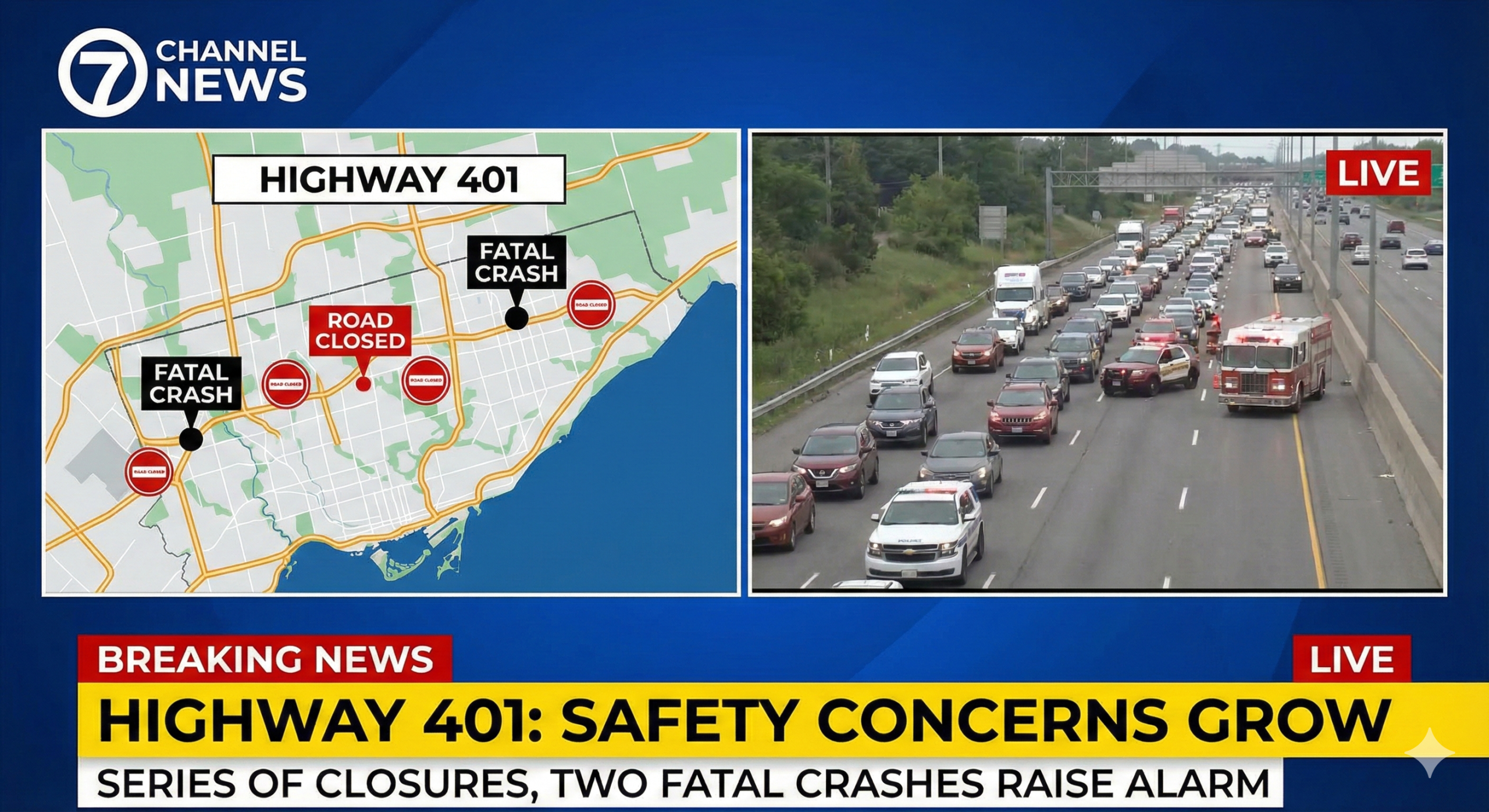
A troubled section of Highway 401 in Southwestern Ontario has been the scene of repeated closures and two tragic fatalities within less than a month, raising serious concerns among commuters and emergency responders. The stretch of highway between Cedar Creek Road in Kitchener and Oxford County Road 29, just west of Drumbo, has seen an unusual concentration of incidents since mid-November, prompting renewed discussions about road safety, driver awareness, and compliance with traffic laws designed to protect motorists and first responders.
While police maintain that there is no specific engineering or structural factor that makes this portion of the highway more dangerous than others, the recent series of events has left many questioning whether enough is being done to prevent further tragedies.
Fatal Collision Involving Transport Truck Claims Life of Young Driver
The first major incident occurred on November 13, when a transport truck violently rear-ended another commercial vehicle on the eastbound lanes of Highway 401. The crash result was devastating. A 26-year-old man from Brampton lost his life at the scene, marking the first of two fatalities on this same stretch of highway within weeks.
The collision prompted an immediate and extended closure of the eastbound lanes, beginning at approximately 7:00 a.m. Emergency crews, including Ontario Provincial Police (OPP), paramedics, and cleanup crews, remained on site throughout the day. It was not until shortly after 5:30 p.m. that traffic flow was finally restored.
The extended shutdown caused major delays for drivers traveling in and around Kitchener, Cambridge, and surrounding communities. Commercial drivers, daily commuters, and long-distance travelers were forced to reroute through local roads, creating congestion in nearby towns and emphasizing the importance of Highway 401 as one of the province’s most vital transportation corridors.
Though investigations into the crash continued, the fatality once again underscored the risks associated with heavy transport traffic on one of Canada’s busiest highways.
Icy Conditions Lead to Multiple Vehicles in the Ditch
Just two weeks after the fatal transport truck crash, the same portion of Highway 401 was shut down again — this time due to sudden and dangerous winter weather conditions. As freezing temperatures swept through the region, icy pavement caused multiple vehicles to lose control.
Several passenger cars and transport trucks slid off the roadway and ended up in roadside ditches. Recovery vehicles were brought in to remove the stranded vehicles, and crews worked for hours to ensure that the roadway was safe for travel.
Unlike the earlier incident in November, this closure did not involve any fatalities. However, it further highlighted the unpredictable nature of driving conditions in the area — particularly during the winter months when ice, snow, and reduced visibility can significantly impact driver reaction time and vehicle control.
Authorities temporarily closed the highway overnight to allow tow trucks and road crews to safely recover the vehicles and treat the pavement. Although drivers were relieved that no lives were lost, the repeated disruptions along this single stretch of highway were becoming increasingly concerning.
Tow Truck Operator Killed While Assisting Motorist
Earlier this week, tragedy struck the same section of Highway 401 yet again. A 42-year-old tow truck operator from Kitchener was fatally injured after being struck by a passing transport truck. The operator had been assisting another motorist at the time of the incident.
Emergency responders rushed to the scene, but the victim succumbed to their injuries. The event sent shockwaves through the local towing and emergency response communities, as well as among drivers who regularly use the route.
This incident highlighted a particularly dangerous reality for first responders and roadside assistance workers who put themselves at risk daily while helping stranded motorists. Whether assisting with a mechanical breakdown, collision recovery, or other roadside emergency, tow truck drivers face significant hazards from passing traffic — especially on narrow shoulders and in poor weather or low-light conditions.
Ontario Provincial Police confirmed that the incident remains under investigation, but it has already reignited concerns over driver behavior around stopped emergency vehicles.
Police Say the Stretch Is Not Uniquely Dangerous
With multiple serious incidents occurring in the same general area, many drivers have questioned whether there is something inherently unsafe about this section of Highway 401. However, Ontario Provincial Police have not identified any particular design flaw or geographic factor that would make it more hazardous than other stretches of the highway.
“There are some stretches that seem to attract collisions or closures for whatever reason,” said Provincial Constable Matthew Foster, who has attended all of the recent incidents. “But as far as a specific reason about this particular stretch of highway, I don’t have anything to offer.”
Foster was also asked whether weather conditions may have played a role in the fatal collision involving the transport truck and the tow truck operator. While he could not comment on the ongoing investigation, he emphasized that weather alone does not cause collisions.
“Weather in and of itself doesn’t cause crashes,” he explained. “But we have to adjust our driving to the weather. Sometimes that means driving much slower so we don’t skid and slide. It is everyone’s responsibility to adapt their driving habits.”
His message serves as a reminder that driver awareness, speed, and reaction time are often the most critical factors in avoiding collisions, especially during winter conditions.
The Importance of Ontario’s Move Over Law
Following the death of the tow truck operator, police have once again called attention to Ontario’s Move Over Law — a regulation that is intended to protect emergency workers and roadside assistance personnel.
Under the law, drivers are required to slow down and, where possible, change lanes when approaching a stopped emergency vehicle with flashing lights. This rule applies to police, fire services, paramedics, and tow truck operators.
Failure to comply with the Move Over Law can result in serious legal consequences. Fines range from $490 to $2,000, drivers may lose demerit points, and in severe cases, jail time of up to six months is possible.
“The Move Over Law exists to prevent exactly what happened this week,” said Foster. “It is meant to protect those who put themselves in harm’s way to help others.”
Despite the law being in place for years, incidents involving emergency vehicles continue to occur, often due to driver distraction, lack of awareness, or failure to properly assess the situation on the road.
Tips for Staying Safe When Pulled Over on the Highway
Police are also reminding drivers of steps they can take to reduce risk if they are forced to pull over on a high-speed highway like the 401 due to mechanical issues, medical concerns, or other emergencies.
Constable Foster advises motorists to pull as far to the right as safely possible and to choose an area that is straight, clear, and highly visible to oncoming traffic. Stopping on curves or hills is especially dangerous due to limited sightlines for approaching drivers.
He also suggested looking for designated emergency turn-around areas, which offer additional shoulder space. While drivers are not allowed to use these turnarounds to reverse direction, they can provide a safer location to stop and wait for assistance.
Whenever possible, drivers should remain in their vehicles with seatbelts fastened and hazard lights activated while awaiting help, especially on busy highways with high-speed traffic.
A Stark Reminder of Highway Dangers
The recent series of closures and fatalities on this section of Highway 401 serves as a powerful reminder of the risks present on high-volume roadways. Commercial vehicles, unpredictable weather, distracted driving, and high speeds all combine to create a potentially deadly environment.
For families and colleagues of the two individuals who lost their lives, these incidents are devastating and deeply personal. For the broader community, they represent a call to reflect on driving habits and road awareness.
Although authorities insist there is nothing uniquely dangerous about this particular stretch of highway, the concentration of incidents in such a short period of time is undeniable. It is also a stark illustration of how quickly routine travel can turn into tragedy.
Conclusion: Awareness, Responsibility, and Prevention
As winter conditions continue to affect Ontario’s roads, police and transportation officials are urging drivers to be extra cautious, slow down, and remain alert — especially in areas where emergency or tow vehicles may be present.
The loss of two lives in one month along the same stretch of highway is a sobering statistic, but it also offers an opportunity to prevent further tragedy. By following traffic laws, respecting roadside workers, and adjusting driving to road conditions, motorists can play a direct role in improving safety for everyone on the road.
In the end, Highway 401 is not just a roadway — it is a shared space. Protecting lives on it is a responsibility that belongs to every driver who travels its lanes.
Leave a Reply