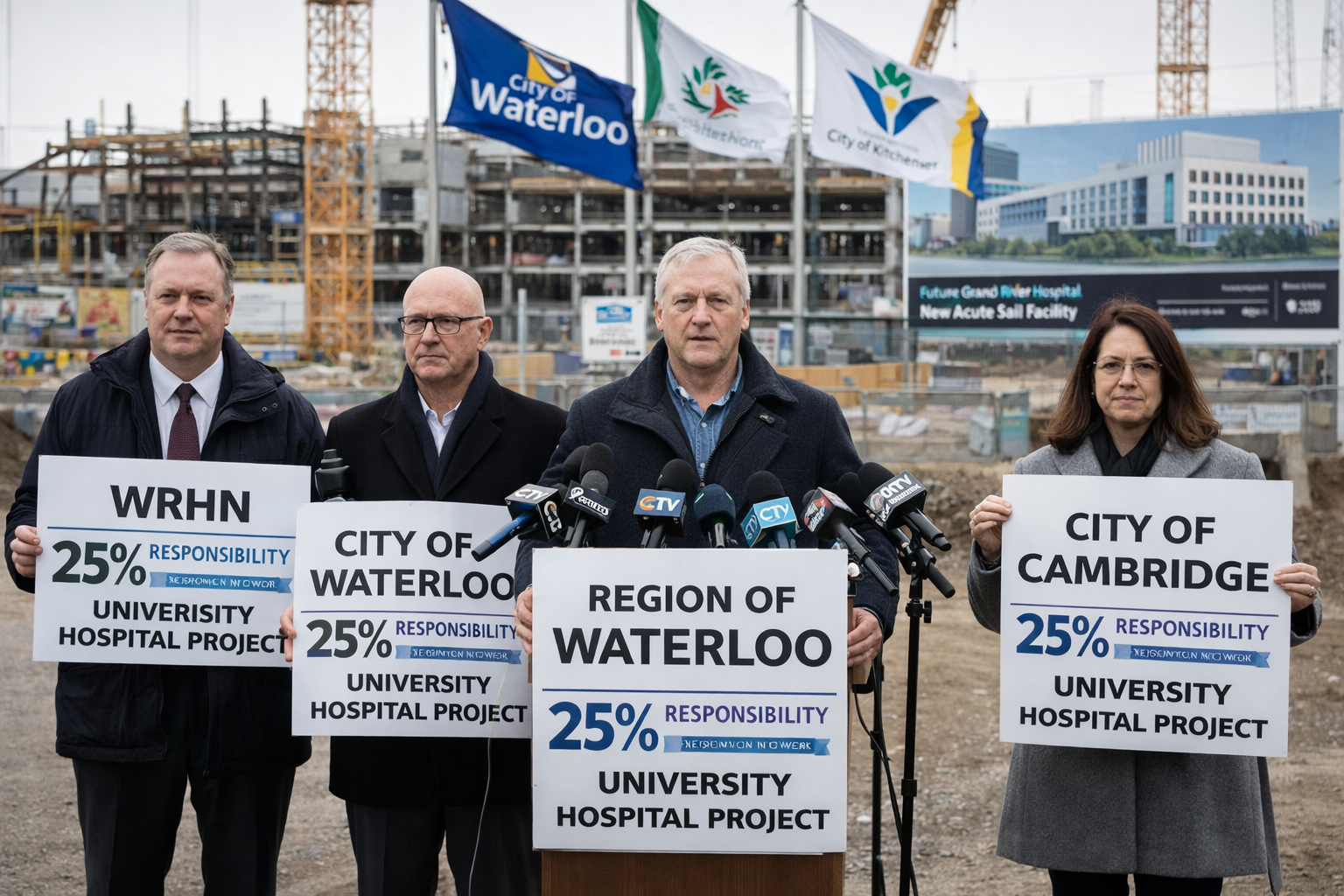
The Waterloo Regional Health Network (WRHN) is preparing to formally engage local municipal leaders in a critical discussion about the financial responsibilities tied to the construction of a new regional hospital at the University of Waterloo. As planning progresses, hospital leadership is emphasizing that community-level funding will be essential to move the project forward, with municipalities and local partners expected to collectively contribute roughly one-quarter of the total project cost.
The issue will take centre stage at an upcoming All Councils meeting, where WRHN President and Chief Executive Officer Ron Gagnon is scheduled to outline both the vision for the new hospital and the financial framework required to make it a reality.
WRHN Leadership to Address All Councils Meeting
Presentation Scheduled in Elmira
Gagnon is set to speak Friday afternoon at the All Councils meeting in Elmira, held at the Township of Woolwich council chambers. The meeting brings together mayors and councillors from across Waterloo Region, offering a rare opportunity for WRHN leadership to directly address nearly every local municipal decision-maker at once.
During the presentation, Gagnon will provide an update on the WRHN @ The University project, a major new healthcare facility planned for lands at the University of Waterloo. The hospital is intended to play a central role in meeting the region’s growing healthcare demands over the coming decades.
Co-presenting alongside Gagnon will be Patrick Gaskin, President and CEO of Cambridge Memorial Hospital, underscoring the collaborative nature of the WRHN system and the regional scope of the project.
Focus on the Local Share Plan
A key component of the presentation will be the Local Share Plan (LSP), a financial requirement set by Ontario’s Ministry of Health. The LSP represents the portion of total project costs that must be covered locally, rather than by provincial funding.
According to WRHN documentation, the Local Share Plan includes the hospital’s share of total project costs, encompassing all eligible associated expenses tied to the development and construction of the new facility.
Gagnon says meeting this requirement is not optional.
“I have a really high level of confidence that we can deliver a local share plan that supports our project,” he told 570 NewsRadio. “Because without it, this project doesn’t happen.”
Understanding the 25% Local Funding Requirement
How Much Will the Community Need to Contribute?
While the overall cost of WRHN @ The University has not yet been finalized, Gagnon acknowledged that local contributions are expected to fall within the range of 25 to 30 per cent of total project costs. That means roughly one-quarter of the funding must be raised through local sources before provincial dollars can be fully secured.
At this stage, Gagnon cautioned that it is still too early to assign a precise dollar value to the Local Share Plan.
“We’re not at a point yet where we can say what that number is,” he said, noting that project scope, design, and phased development will all influence the final cost.
Ministry of Health Requirement
The Local Share Plan is a mandatory component of hospital capital projects in Ontario. The Ministry of Health requires communities to demonstrate financial commitment to new healthcare infrastructure before approving full provincial funding.
This model is designed to ensure local accountability and engagement, but it also places a significant responsibility on municipalities and hospital foundations to raise substantial funds.
Economic and Healthcare Benefits Highlighted
“We Gain 100% of the Benefits”
Despite the financial challenge, Gagnon emphasized that the return on investment for the community is substantial. While local governments and partners may contribute only a fraction of the total cost, the benefits—both healthcare-related and economic—are fully realized at the local level.
“Locally, we might contribute 25 per cent to 30 per cent of the overall costs,” Gagnon explained. “We gain 100 per cent of the benefits.”
Those benefits include improved access to care, modern medical facilities, expanded services, and increased system capacity to serve a rapidly growing population.
Significant Economic Impact
Beyond healthcare outcomes, WRHN leadership highlighted the economic ripple effects associated with hospital construction and operation. Gagnon noted that every dollar invested locally generates meaningful economic activity within the region.
“For every dollar we invest, there’s a total output of $1.53 locally,” he said.
That economic impact includes job creation, local procurement, increased commercial activity, and long-term employment tied to hospital operations.
How the Local Share Will Be Funded
Three Primary Funding Sources Identified
Gagnon outlined three main sources that will be used to generate the local share required for the new hospital:
-
Hospital-generated revenue
-
Fundraising by the WRHN Foundation
-
Contributions from regional and municipal governments
Each source will play a distinct role in assembling the overall funding package.
Hospital Revenue Streams
Hospital-generated revenue will form one part of the local share. According to presentation materials, this includes income from parking services, on-site retail and food operations, and revenue generated through preferred accommodation options.
These revenue streams are commonly used in hospital financing models and are expected to provide a steady contribution over time.
Role of the WRHN Foundation
Fundraising will be led by the WRHN Foundation, which brings together local hospital foundations under a unified structure. The foundation will be responsible for engaging donors, businesses, and community partners in a large-scale capital fundraising campaign.
Previous provincial funding announcements and local fundraising successes suggest there is momentum behind the project, but the scale of the required local share means sustained fundraising efforts will be essential.
Municipal Contributions Required
The remaining portion of the local share will come from the Region of Waterloo and its seven area municipalities. While details on how costs will be allocated among municipalities have not yet been finalized, the upcoming All Councils meeting marks an early step in those discussions.
Municipal leaders will be asked to consider how best to support the project through budget planning, long-term financial strategies, and potential inter-municipal cooperation.
Long-Term Vision for Regional Healthcare
Planning Through 2045
In addition to funding discussions, Gagnon’s presentation will provide a broader update on the phased development of WRHN @ The University and the long-term vision for all WRHN hospitals through 2045.
The plan is designed to align hospital infrastructure with projected population growth, technological advancements, and evolving healthcare needs across the region.
Preparing for a Population of One Million
Gagnon stressed that the new hospital is not simply a response to current pressures, but a proactive investment in the region’s future.
“If we want to be 1-million ready, we need to have a modern healthcare infrastructure,” he said. “And this is the key requirement to do that.”
Waterloo Region continues to experience rapid growth, driven by immigration, economic expansion, and a strong post-secondary sector. Healthcare leaders warn that without significant infrastructure investment, the system will struggle to keep pace with demand.
Next Steps and Municipal Engagement
Building Consensus Across the Region
The All Councils meeting represents an important milestone in building regional consensus around the project. While funding decisions will ultimately be made at individual council tables, the collective discussion is intended to ensure alignment and shared understanding of the stakes involved.
As planning continues, WRHN leadership is expected to hold further discussions with councils, stakeholders, and the public to refine the Local Share Plan and advance the project toward approval.
A Pivotal Moment for Regional Healthcare
With provincial support already committed and planning moving forward, the ability of WRHN and local municipalities to raise the required 25 per cent local share will be a determining factor in whether the hospital proceeds on schedule.
The coming months are expected to bring clearer cost estimates, more detailed funding strategies, and continued dialogue between healthcare leaders and municipal governments.
Conclusion: Local Investment Key to Unlocking a Major Healthcare Project
The proposed WRHN @ The University hospital represents one of the most significant healthcare infrastructure projects in Waterloo Region’s history. While the requirement for local partners to fund approximately 25 per cent of the cost presents a major challenge, WRHN leadership argues that the long-term benefits far outweigh the investment.
With improved healthcare access, substantial economic returns, and a system better prepared for a growing population, the project is being positioned as a cornerstone of the region’s future. As municipal leaders consider their role in funding the Local Share Plan, the decisions made in the months ahead will shape the state of healthcare in Waterloo Region for decades to come.
Leave a Reply